

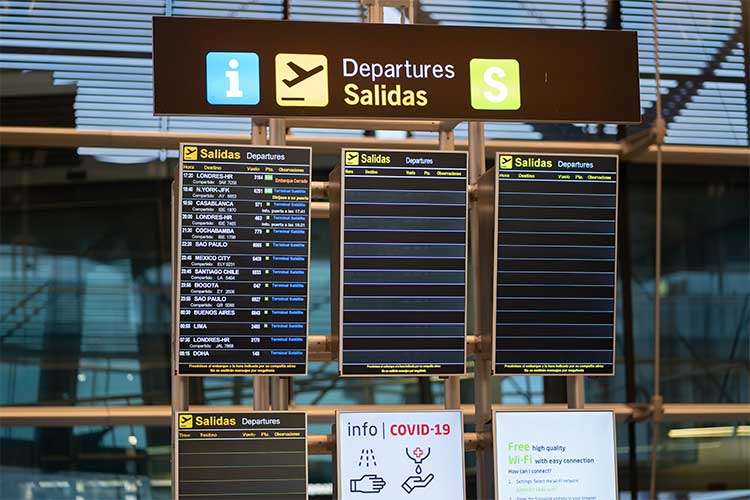
Airport transportation is one of the most sensitive parts of any trip. Flight schedules can change at any moment — a storm, a crowded runway, extended security checks or an internal adjustment in air traffic control can shift the landing time by tens of minutes.
And for the traveler, this variability creates stress:
– Will the driver arrive on time?
– If the flight is delayed, do I need to notify someone?
– What happens if I land earlier?
This is where the role of flight monitoring becomes essential. When done professionally, the synchronization between the flight and the driver happens automatically. The passenger steps off the plane knowing everything has already been adjusted in the background: pickup time, meeting point, route planning.
For business travelers, this level of predictability isn’t a luxury — it’s a necessity. A well-timed airport transfer is often the first indication that their day will unfold smoothly.
2. What flight monitoring actually means (in simple terms)
Flight monitoring is the process through which the transfer company tracks the status of the aircraft in real time, using specialized systems and platforms.
It’s not just checking the airport website — it means having access to detailed, constantly updated data.
A professional monitoring system provides information such as:
– actual departure and landing time,
– delays or early arrivals,
– gate or terminal changes,
– air-traffic disruptions that may affect arrival,
– estimates based on real airport flow, not only the airline’s original schedule.
These updates are refreshed frequently, so the driver relies on accurate data rather than assumptions.
The result?
The actual pickup moment is based on coordination, not guesswork.
3. How a professional private driver uses this data in real time
Flight monitoring isn’t a passive process. For a trained chauffeur, every update translates into a practical decision.
Automatic adjustment of pickup time
If a flight is delayed by 20, 40 or even 90 minutes, the pickup time shifts automatically. The passenger doesn’t need to call, explain or apologize — everything aligns without any effort on their side.
Handling early landings
Sometimes the aircraft lands earlier than scheduled. For the driver, this requires a quick reaction:
– leaving for the airport ahead of time,
– choosing the fastest route,
– adjusting the pickup precisely so the passenger is never left waiting.
Choosing the optimal route based on real arrival time
Traffic can be unpredictable, especially in large cities. A professional chauffeur uses real landing data to decide:
– which route is the most efficient,
– how much time remains until the passenger exits the terminal,
– whether airport congestion or restrictions require route adjustments.
The outcome?
No wasted time, no uncertainty, and a seamless experience even when the flight doesn’t follow the original schedule.
4. Why flight monitoring eliminates stress for the passenger
For the passenger, a successful transfer is one where no questions need to be asked.
Professional monitoring removes exactly the situations that create unnecessary stress before or after a flight.
No need to notify anyone about delays
The traveler doesn’t have to refresh the flight status or send late-night messages. Someone else is doing that — correctly and in real time.
No risk of being left without a driver
Because the company tracks the flight, the chauffeur won’t leave too early, won’t cancel the ride and won’t put the passenger in an uncertain situation.
Every step is clear, without improvisations
The passenger knows exactly:
– who is waiting for them,
– where the meeting point is,
– how the pickup process unfolds.
No matter how packed the day is, this level of clarity frees mental space for what truly matters — a meeting, a presentation or simply decompressing after a long flight.
A smooth experience even when things don’t go as planned
Delays, early arrivals, terminal changes — all are handled without burdening the traveler.
“Getting from A to B” stops being a logistical challenge and becomes a natural transition between two moments of the day.
5. The benefits for companies: predictability, image and efficiency
For companies, flight monitoring is not just a technical detail.
It is an organizational tool that reduces risk and strengthens the company’s image.
Avoiding delays and disrupted schedules
When a guest, speaker or team member arrives on time, the event agenda stays intact.
Delays become exceptions, not chain-reaction problems that impact the entire day.
Full control over logistics
HR departments, office managers or event coordinators no longer have to track flights or manage real-time transport changes.
The transfer partner handles this professionally, allowing internal teams to stay focused on their core tasks.
A consistent and reliable image for guests
A guest who is picked up on time, without confusion or waiting, immediately understands the company’s level of professionalism.
It’s the kind of detail that speaks for itself.
Reduced logistical errors
Changed gates, modified terminals, adjusted arrival times — all can cause chaos.
Real-time monitoring means prevention, not reaction.
For companies, prevention saves time, money and reputation.
6. Why flight monitoring should be a non-negotiable criterion when choosing an airport transfer service
In a market where many transportation providers promise the same thing, flight monitoring is one of the rare elements that clearly separates a professional service from an ordinary one.
It signals true professionalism
A company that invests in monitoring systems and driver training treats transportation as a premium service, not a casual ride.
It shows that the passenger is at the center
Pickup time is dictated by the actual flight status, not by the driver’s routine.
The service adjusts to the traveler — not the other way around.
It prevents unnecessary conflicts or frustrations
When everything is predictable, there are no misunderstandings about delays, extra charges or missed connections.
The experience remains consistent and straightforward.
It makes a difference in critical situations
Early landings, bad weather, crowded terminals — these are moments when taxis or ridesharing can fail.
Professional monitoring keeps the entire process under control even in unpredictable conditions.
Conclusion – Why flight monitoring is the foundation of a reliable airport transfer
Flight monitoring is not a technical extra or a “nice-to-have.”
It is the mechanism that enables a stress-free, well-coordinated and dependable airport transfer — for both travelers and companies.
When you know someone is tracking the flight in real time, adjusting pickup times, managing changes and waiting regardless of the situation, you gain something essential: predictability.
And in business travel — or any type of travel — predictability is one of the most valuable forms of comfort.
If you want your journey from the airport to start the right way, the smoothness of the service depends on one thing:
real-time information and a partner who truly knows what they’re doing.